
Ankle Rehab After a Sprain: Step-by-Step Guide
Complete ankle sprain rehabilitation protocol including RICE, proprioception training, strengthening, and return-to-sport criteria.

Ankle sprains are the most common musculoskeletal injury, accounting for approximately 2 million injuries per year in the United States alone. While many people dismiss ankle sprains as minor injuries, inadequate rehabilitation leads to chronic ankle instability in up to 40% of cases.
Proper rehabilitation — from initial management through proprioception training and return to sport — is essential for full recovery and preventing recurrent sprains. This guide covers the complete rehabilitation process from the moment of injury through return to full activity.
Understanding Ankle Sprains
Ankle sprains involve stretching or tearing of the ligaments that stabilize the ankle joint. The lateral (outside) ankle is injured in approximately 85% of cases, most commonly the anterior talofibular ligament (ATFL). Sprains are graded by severity:
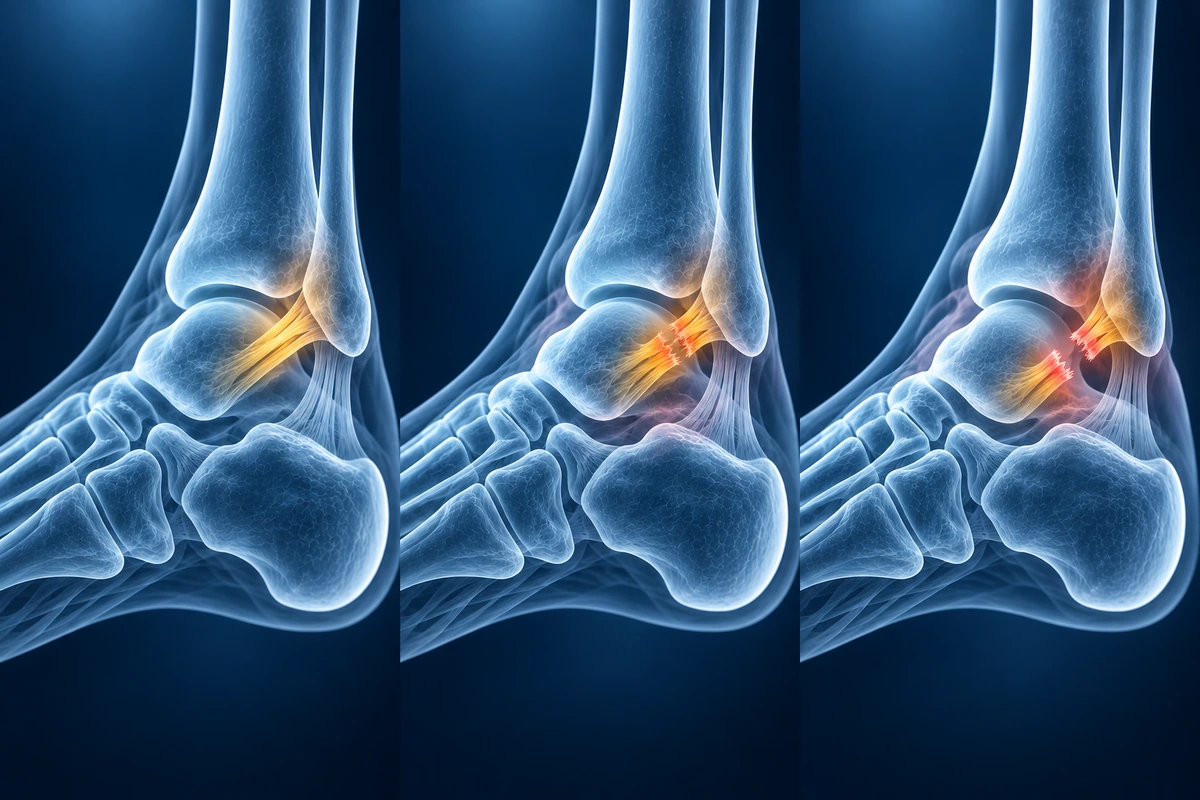
- Grade 1: ligament stretching with mild swelling and no instability (recovery 1-3 weeks)
- Grade 2: partial tear with moderate swelling, bruising, and some laxity (recovery 4-8 weeks)
- Grade 3: complete tear with significant swelling, bruising, and joint instability (recovery 8-12+ weeks)
Phase 1: Acute Management — PRICE Protocol (Days 0-7)
The immediate goals are to reduce swelling, control pain, and protect the injured ligaments. The modern approach uses PRICE: Protection (ankle brace or taping, crutches if unable to walk without a limp), Rest (relative rest — not complete immobilization), Ice (15-20 minutes every 2-3 hours for the first 48-72 hours), Compression (elastic bandage or compression sleeve), and Elevation (ankle above heart level when resting).
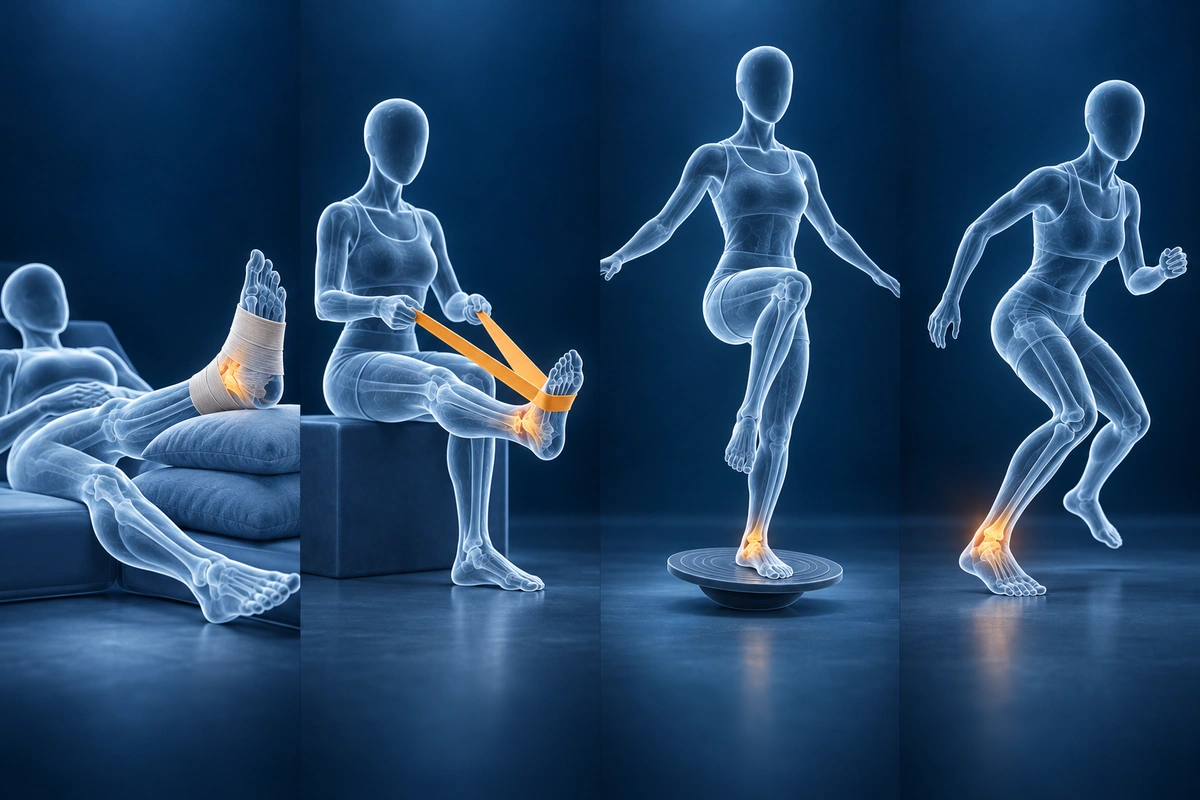
Early controlled movement is beneficial — gentle ankle circles, alphabet tracing with the toes, and ankle pumps can begin within the first 1-2 days as pain allows. Prolonged immobilization (more than 7-10 days) is now discouraged as it leads to muscle atrophy, joint stiffness, and slower recovery. An air-stirrup brace or lace-up ankle brace provides support while allowing controlled motion.
Phase 2: Restoration of Motion and Early Strengthening (Weeks 1-3)
Once acute swelling begins to subside, the focus shifts to restoring full ankle range of motion and beginning strengthening exercises. Goals include achieving full dorsiflexion equal to the other side, pain-free walking with a normal gait pattern, and initiating resistance exercises.
- Towel stretches for the calf (seated with towel looped under the foot)
- Standing calf stretches (straight knee for gastrocnemius, bent knee for soleus)
- Resistance band exercises in all four directions (dorsiflexion, plantarflexion, inversion, eversion)
- Toe raises (bilateral progressing to single-leg)
- Gentle balance exercises (double-leg stance on unstable surface progressing to single-leg)
Phases 3-4: Proprioception Training and Return to Sport (Weeks 3-12)
Proprioception — the ability to sense ankle position without looking — is severely disrupted after a sprain and is the primary reason sprains recur. Research shows 6-8 weeks of proprioception training reduces recurrence by 35-50%. Progress from single-leg stance on firm surfaces to unstable surfaces (wobble boards, BOSU ball), then add perturbation training and dynamic challenges. The final phase (weeks 6-12) adds progressive running, agility drills, and sport-specific training. Return-to-sport criteria include single-leg hop at least 90% of the other side and full confidence in the ankle.
Key Takeaways
- Inadequate rehabilitation leads to chronic instability in up to 40% of ankle sprains
- Early controlled movement (not prolonged immobilization) promotes faster healing
- Proprioception training is the single most important component for preventing recurrence
- Full dorsiflexion restoration is critical — restricted dorsiflexion is a major risk factor for re-sprain
- Recovery timeline: Grade 1 (1-3 weeks), Grade 2 (4-8 weeks), Grade 3 (8-12+ weeks)
- Ankle bracing during sport for 6-12 months after injury reduces recurrence risk
Frequently Asked Questions
Should I get an X-ray or MRI after an ankle sprain?
Not every ankle sprain needs imaging. X-rays are recommended if you cannot bear weight immediately after the injury or if there is tenderness over specific bony landmarks (Ottawa Ankle Rules). MRI is typically reserved for sprains that fail to improve after 4-6 weeks of appropriate treatment. For more on imaging decisions, see our guide on MRI vs X-ray.
When can I walk normally after an ankle sprain?
With Grade 1 sprains, most people walk normally within 1-2 weeks. Grade 2 sprains typically allow normal walking by 2-4 weeks. Grade 3 sprains may require 4-6 weeks or longer before a normal gait pattern is achieved. Use crutches as needed to avoid limping — walking with a limp creates compensatory patterns that can cause problems in the knee, hip, and back.
Can a Grade 3 ankle sprain heal without surgery?
Yes, the vast majority heal without surgery. Even with a complete ligament tear, functional rehabilitation produces good outcomes in 80-90% of patients. Surgery is reserved for those who develop chronic instability despite thorough rehabilitation.
What is chronic ankle instability?
Chronic ankle instability is a condition where the ankle repeatedly gives way or feels unstable, particularly on uneven surfaces or during sport. It develops in approximately 20-40% of people after an ankle sprain, primarily due to inadequate rehabilitation — specifically, failure to restore proprioception and peroneal muscle strength. Treatment involves structured rehabilitation; if this fails, surgical ligament reconstruction may be needed.
Related Articles
Learn about ATFL and CFL healing potential, conservative versus surgical treatment, and when chronic instability requires intervention.
Understand common ankle conditions including ligament sprains, fractures, Achilles tendon tears, peroneal injuries, and osteochondral defects.
Related Conditions
Ready to analyze your imaging? Upload your MRI or X-ray for AI-powered analysis
Upload your MRI or X-ray DICOM files for private, AI-powered analysis. 4 models analyze independently — raw scan files stay in your browser.
Start AnalysisMedical Disclaimer: This page is for informational and educational purposes only. It does not constitute medical advice, diagnosis, or treatment. AI-generated analysis may contain errors. Always consult a qualified healthcare professional for medical decisions. Full Disclaimer