
Symptômes fréquents
- Douleur de la cheville médiale et du médio-pied le long du trajet du tendon tibial postérieur (TTP) de la malléole médiale jusqu'au naviculaire
- Déformation progressive en pied plat — perte de la voûte plantaire médiale visible lors de l'évaluation en charge
- Incapacité à effectuer une montée sur la pointe d'un pied, ou douleur et valgus talonnaire asymétrique lors de la tentative
- Gonflement le long de la cheville médiale derrière la malléole médiale dans la gaine du TTP
- Signe des « trop de doigts » — visibilité latérale excessive des orteils lorsque le patient est vu de dos en raison d'un valgus de l'arrière-pied et d'une abduction de l'avant-pied
- Pied plat rigide au stade avancé avec arthrose sous-talienne et médiotarsienne provoquant des douleurs du talon au repos
Dysfonction du tendon tibial postérieur : analyse IRM et radiographie par IA
Analyse par IA de la dysfonction du tibial postérieur sur IRM de la cheville. Comprenez la dégénérescence tendineuse, les déchirures et la déformation du pied plat associée. 4 modèles d'IA expliquent la morphologie tendineuse et les résultats du ligament calcanéo-naviculaire en langage clair.
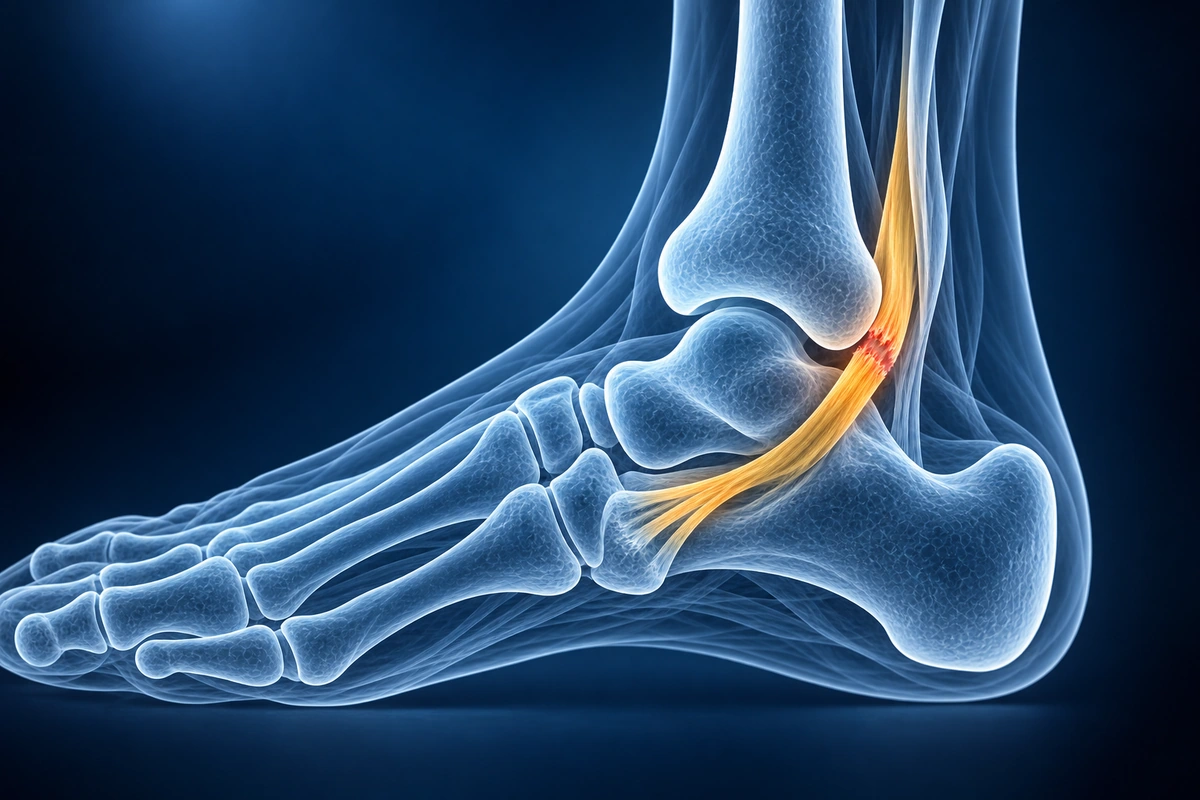
La dysfonction du tendon tibial postérieur (DTTP) est la cause la plus fréquente de pied plat acquis de l'adulte. Le tendon tibial postérieur soutient l'arche longitudinale médiale et contrôle l'inversion de l'arrière-pied pendant la marche. Lorsque le tendon dégénère, il s'allonge progressivement et perd son avantage mécanique, entraînant un effondrement de la voûte et un valgus de l'arrière-pied. La DTTP est stadifiée de I à IV : le Stade I implique une tendinopathie avec une voûte normale, le Stade II montre une déformation en pied plat souple, le Stade III présente une déformation rigide avec arthrose sous-talienne, et le Stade IV ajoute une bascule en valgus de la cheville. L'IRM est essentielle pour évaluer l'intégrité tendineuse, stadifier la maladie et évaluer les lésions associées du ligament calcanéo-naviculaire plantaire. Notre consortium d'IA analyse la morphologie tendineuse, les modifications péri-tendineuses et l'alignement de l'arrière-pied sur plusieurs séquences.
Ce que nous recherchons à l'imagerie
- Épaississement ou amincissement du tendon avec augmentation du signal intratendineux à l'IRM
- Déchirures longitudinales en fissure du tendon tibial postérieur sur les images axiales
- Atténuation ou déchirure du ligament calcanéo-naviculaire plantaire (supéro-médial)
- Ténosynovite péri-tendineuse avec liquide entourant la gaine tendineuse
- Alignement en valgus de l'arrière-pied et découverte de la tête du talus sur les vues en charge
- Œdème du sinus du tarse et modifications dégénératives de l'articulation sous-talienne aux stades avancés
Questions fréquentes
Quelles séquences et signes IRM confirment le dysfonctionnement du tendon tibial postérieur ?
La séquence axiale DP-FS au niveau de la malléole médiale est la coupe principale. Le PTTD de grade I montre un liquide péri-tendineux et une distension de la gaine tendineuse avec des fibres intactes et un calibre allant jusqu'au double du fléchisseur commun des orteils (FDL). Le grade II démontre des fissures longitudinales intratendineaux, un amincissement tendineux focal ou un signal T2 hétérogène avec élongation et pied plat progressif sur les radiographies en charge. Le grade III montre une rupture complète avec un espace comblé de liquide. Les images STIR coronales évaluent l'intégrité du ligament calcanéo-naviculaire — une déchirure concomitante (faisceau calcanéo-naviculaire supéro-médial) accélère la progression de la déformation.
Comment le stadification IRM assistée par IA de la DTTP guide-t-elle la planification chirurgicale ?
Les modèles d'IA quantifient la surface de section du TTP, la longueur de la déchirure longitudinale et le signal du ligament calcanéo-naviculaire plantaire sur IRM, en corrélant la pathologie avec la classification de Johnson-Strom utilisée chirurgicalement. Le stade I (ténosynovite, tendon intact) est traité par débridement ; le stade II (tendon allongé et atténué avec déformation flexible) nécessite un transfert du FDL et une ostéotomie calcanéenne ; le stade III (pied plat rigide avec arthrose sous-talienne) requiert une arthrodèse triple. La mesure par IA du rapport de diamètre TTP/FDL et de l'étendue de la déchirure du ligament calcanéo-naviculaire réduit la variabilité inter-lecteur et détermine la procédure reconstructive permettant la meilleure restauration de l'arche plantaire.
La DTTP peut-elle être distinguée de la tendinopathie des autres tendons de la cheville médiale à l'IRM ?
Oui. La cheville médiale contient les tendons Tom, Dick et Harry — tibial postérieur, FDL et long fléchisseur de l'hallux (FHL) — dans le tunnel tarsien. Les séquences axiales séparent clairement chaque tendon par sa position : le TTP est le plus antérieur et le plus grand, directement en arrière de la malléole médiale, s'insérant sur la tubérosité du naviculaire. Le FHL est positionné postérieurement entre les processus taliens médial et latéral — une ténosynovite isolée du FHL produit une douleur postérieure de la cheville et un ressaut du gros orteil. L'examen IRM assisté par IA cartographie l'anomalie de signal et de calibre sur le tendon spécifique, guidant l'injection ciblée ou l'intervention chirurgicale.
Importez vos images pour rechercher Dysfonction du tendon tibial postérieur
Téléversez vos fichiers DICOM d'IRM ou de radiographie pour une analyse privée assistée par IA. 4 modèles analysent indépendamment : vos fichiers d'examen bruts restent dans votre navigateur.
Téléverser et analyserAvertissement médical : Cette page est uniquement à des fins informatives et éducatives. Elle ne constitue pas un avis médical, un diagnostic ou un traitement. L'analyse générée par AI peut contenir des erreurs. Consultez toujours un professionnel de santé qualifié pour les décisions médicales. Avertissement complet