Sprunggelenkverletzungstypen erklärt: Verstauchungen bis Achillessehnenrisse
Verstehen Sie häufige Sprunggelenkerkrankungen einschließlich Bandverstauchungen, Frakturen, Achillessehnenrissen, Peronealverletzungen und osteochondralen Defekten.
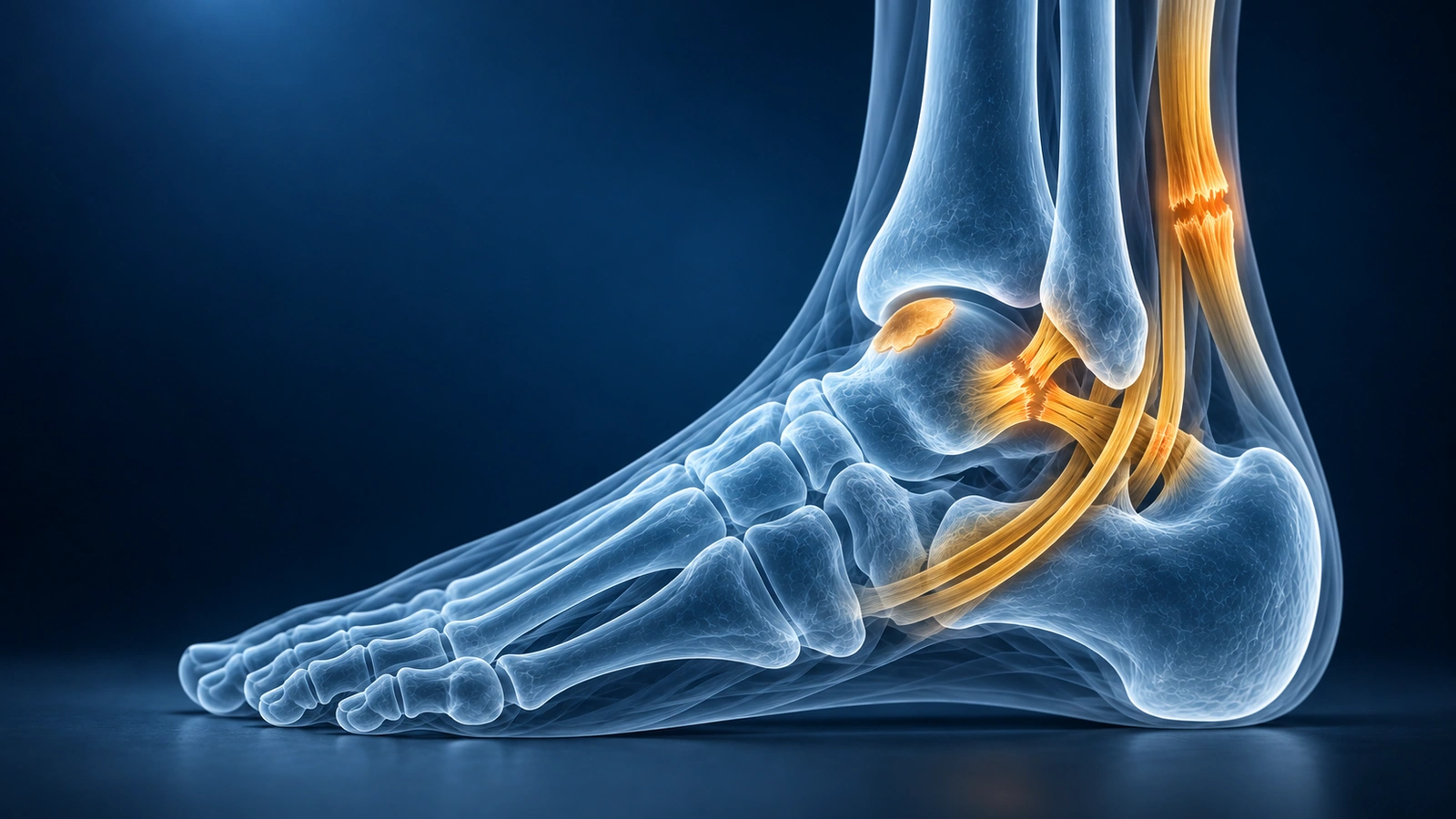
Das Sprunggelenk ist ein Belastungsgelenk, das beim Laufen und Springen Kräfte bis zum Fünffachen des Körpergewichts aushält. Diese mechanische Anforderung macht das Sprunggelenk anfällig für vielfältige Verletzungen der Bänder, Sehnen, Knochen und des Knorpels. Das Erkennen verschiedener Sprunggelenksverletzungstypen hilft Patienten, ihre Diagnose zu verstehen.
Laterale Bandverstauchungen
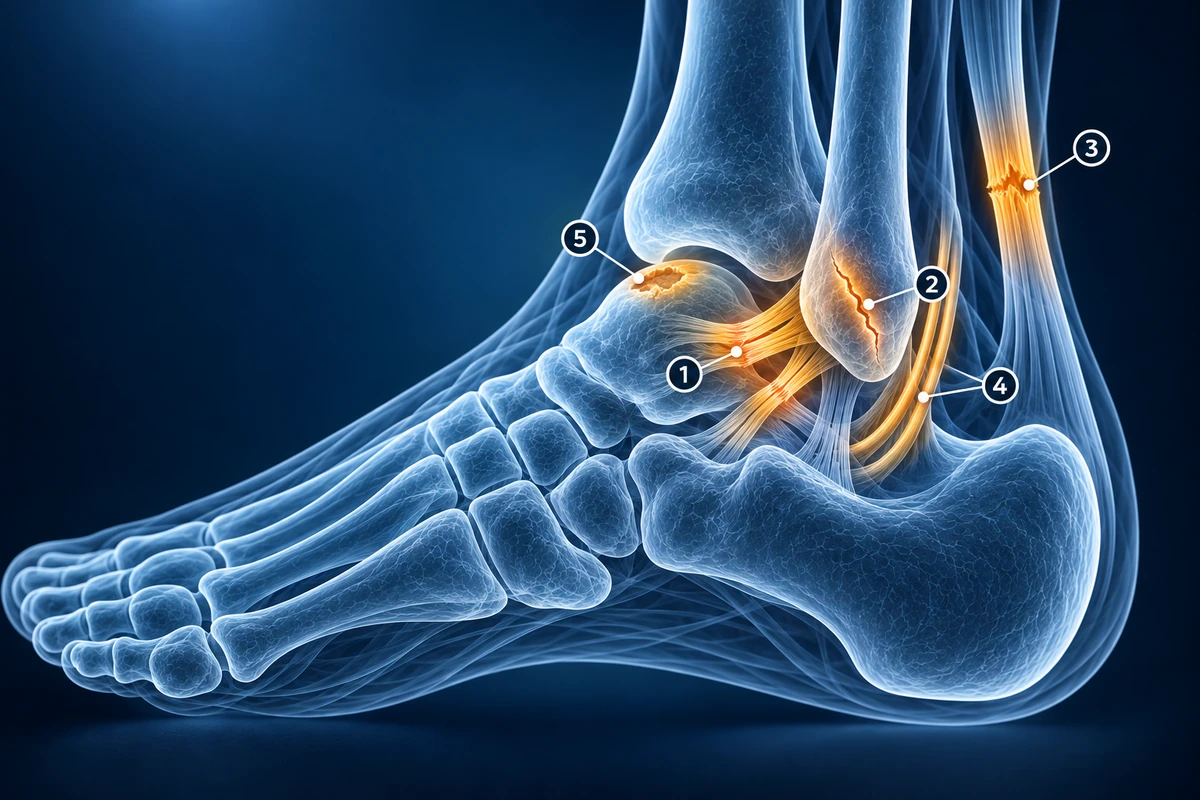
Sprunggelenksdistorsionen machen 85 % aller Sprunggelenkverletzungen aus. Der laterale Bandkomplex (ATFL, CFL und PTFL) ist bei Inversionsverletzungen am häufigsten betroffen. Distorsionen reichen von Grad 1 (Dehnung) bis Grad 3 (vollständige Ruptur). Die meisten heilen mit funktioneller Rehabilitation, jedoch entwickeln bis zu 20 % eine chronische Instabilität. Zu Heilungserwartungen siehe unseren Artikel zur Bandruptur am Sprunggelenk ohne Operation.
Sprunggelenkfrakturen
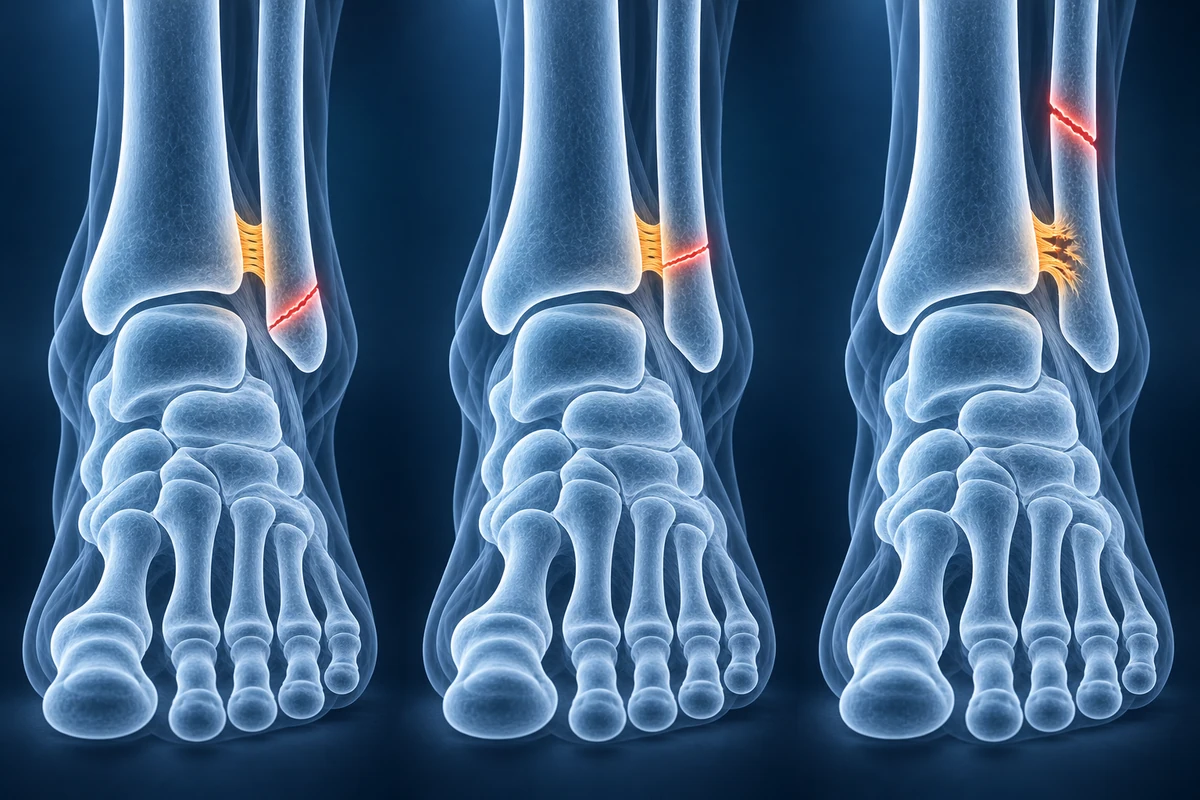
Sprunggelenkfrakturen betreffen einen oder mehrere Malleolen (medial, lateral oder posterior). Die Weber-Klassifikation unterteilt Fibulafrakturen nach ihrer Beziehung zur Syndesmose: Typ A (unterhalb), Typ B (auf Höhe) und Typ C (oberhalb). Stabile, nicht dislozierte Frakturen können mit einer Orthese oder einem Gips behandelt werden, während dislozierte oder instabile Frakturen eine operative Fixation erfordern. Die Syndesmose (Syndesmosenverletzung) muss beurteilt werden, da ihre Verletzung Behandlung und Erholung wesentlich beeinflusst.
Achillessehnenriss
Die Achillessehne ist die größte und stärkste Sehne im Körper, ist jedoch anfällig für Rupturen, insbesondere bei mittelalten Freizeitsportlern. Patienten beschreiben oft ein plötzliches Knallen gefolgt von Schwierigkeiten beim Gehen und Abstoßen. Der Thompson-Test (Wadenkompression mit fehlender Fußflexion) ist hochdiagnostisch. Die Behandlung ist entweder operative Reparatur oder funktionelle Schienung mit frühzeitiger Mobilisierung, beide mit vergleichbaren Ergebnissen.
Peronealsehnen-Verletzungen
Die Peronealsehnen verlaufen hinter dem Außenknöchel und sind wichtig für Pronation und Sprunggelenksstabilität. Verletzungen umfassen Tendinitis, Risse (besonders des M. peroneus brevis) und Subluxation. Diese Verletzungen koexistieren häufig mit chronischer Instabilität und können bei der Erstbeurteilung übersehen werden. MRT zeigt Sehnenverdickung, Längsrisse oder Verschiebung aus der retromalleolären Rinne.
Osteochondrale Defekte des Talus
Osteochondrale Defekte (OCD) betreffen den Knorpel und den darunter liegenden Knochen des Talusdoms. Sie entstehen häufig nach Sprunggelenksverstauchen oder -frakturen und verursachen tiefen Sprunggelenkschmerz, Schwellung und mechanische Symptome wie Einklemmen oder Blockieren. MRT ist das optimale Bildgebungsverfahren zur Erkennung und Klassifizierung von OCD. Kleine, stabile Läsionen können konservativ behandelt werden, während große oder instabile Defekte in der Regel arthroskopische Versorgung erfordern.
Zusammenfassung
- Laterale Bandverstauchungen sind die häufigste Sprunggelenkverletzung und die meisten heilen konservativ
- Die Stabilität der Sprunggelenkfraktur bestimmt, ob eine operative oder konservative Behandlung angemessen ist
- Achillessehnenrupturen können operativ oder mit funktioneller Orthesenbehandlung mit vergleichbaren Ergebnissen behandelt werden
- Peronealsehnen-Verletzungen und osteochondrale Defekte sind häufig mit chronischer Sprunggelenkinstabilität assoziiert
Häufige Fragen
Wie kann ich feststellen, ob mein Sprunggelenk verstaucht oder gebrochen ist?
Die Ottawa-Ankle-Regeln helfen, die Notwendigkeit eines Röntgenbildes zu bestimmen: Wenn Sie nach der Verletzung und in der Notaufnahme vier Schritte tragen können und keine Druckempfindlichkeit über den Malleolus-Knochen besteht, ist eine Fraktur unwahrscheinlich. Bei Zweifel sind Röntgenbilder eine schnelle und kostengünstige Möglichkeit, Frakturen definitiv auszuschließen.
Was ist eine hohe Sprunggelenkverstauchung?
Eine hohe Sprunggelenkverstauchung (Syndesmoseverletzung) schädigt die Bänder zwischen Tibia und Fibula oberhalb des Sprunggelenks. Sie ist schwerwiegender als eine typische laterale Verstauchung und benötigt deutlich länger zur Heilung (6 bis 12 Wochen gegenüber 2 bis 6 Wochen). Sie tritt häufig bei Kontaktsportarten auf und verursacht Schmerzen bei Außenrotation des Fußes. Schwere Fälle können eine operative Fixierung erfordern.
Verwandte Artikel
Verstehen Sie Ihren Sprunggelenk-MRT-Befund einschließlich Bandbeurteilung, Sehnenbeurteilung und Erkennung osteochondraler Läsionen.
Erfahren Sie mehr über das Heilungspotenzial von ATFL und CFL, konservative versus operative Behandlung und wann chronische Instabilität eine Intervention erfordert.
Verwandte Erkrankungen
Bereit für die Analyse Ihrer Bildgebung? Laden Sie Ihr MRT oder Röntgenbild zur KI-gestützten Analyse hoch
Laden Sie Ihre MRT- oder Röntgen-DICOM-Dateien für eine private, KI-gestützte Analyse hoch. 4 Modelle analysieren unabhängig voneinander – die Rohdaten Ihrer Scans bleiben in Ihrem Browser.
Analyse startenMedizinischer Haftungsausschluss: Diese Seite dient nur zu Informations- und Bildungszwecken. Sie stellt keine medizinische Beratung, Diagnose oder Behandlung dar. KI-generierte Analysen können Fehler enthalten. Konsultieren Sie für medizinische Entscheidungen immer qualifiziertes medizinisches Fachpersonal. Vollständiger Haftungsausschluss